Welcome Message

Unus pro omnibus, omnes pro uno -- One for all, all for one

Welcome To Our Mutual Support Community Web Site
(Formerly Known As "The Intel Eliminati" - TIE)
Showing posts with label Higher Education. Show all posts

Tuesday, June 5, 2018

Student Loan Debt Reached All Time High of
$1,521,019,350,000
in Q1 of 2018


Student Loan Debt Reached All Time High of $1,521,019,350,000 (more than 1.5 Trillion dollars)  in Q1 of 2018. Consequently, outstanding student debt currently exceeds auto loan debt ($1.1 trillion) and credit card debt ($977 billion). Considering that 42% of people who've gone to college took out debt, this number has high significance on the future of our economy and the future welfare of young families. According to the College Board, "In 2015-16, the 60% of bachelor’s degree recipients from public and private nonprofit institutions who borrowed graduated with an average of $28,400 in debt"

A recent FRB Board of Governors (FRB-BOG) report on the Economic Well-Being of U.S. Households in 2017, published in May 2018 informs us about the student debt situation:

Over half of college attendees under age 30 took on some debt to pay for their education. Most borrowers are current on their payments or have successfully paid off their loans, although those who failed to complete a degree and those who attended for-profit institutions are more likely to have fallen behind on their payments. • Among those making payments on their student loans, the typical monthly payment is between $200 and $300 per month. • Nearly one-fourth of borrowers who went to forprofit schools are behind on their loan payments, versus less than one-tenth of borrowers who went to public or private not-for-profit institutions.


Click on image to enlarge detail
As the table below shows, many families have taken debt to finance education of their children and/or grandchildren. This creates a "spillover effect" on debt ownership that continues to burden older adults, even after their offspring have become independent adults.

Click on image to enlarge detail


Here are some interesting anecdotes quoted from the same FRB-BOG report:
  • Nearly 25 percent of young adults under age 30, and 10 percent of all adults, receive some form of financial support from someone living outside their home.
  • Four in 10 adults, if faced with an unexpected expense of $400, would either not be able to cover it or would cover it by selling something or borrowing money. This is an improvement from half of adults in 2013 being ill-prepared for such an expense
  • Over one-fifth of adults are not able to pay all of their current month’s bills in full.
  • Over one-fourth of adults skipped necessary medical care in 2017 due to being unable to afford the cost
  • Nearly half of adults age 22 and older currently live within 10 miles of where they lived in high school, but those who have moved farther from home are more likely to be satisfied with the overall quality of their neighborhood.
  • Out-of-pocket spending for health care is a common unexpected expense that can be a substantial hardship for those without a financial cushion. As with the small financial setbacks discussed above, many adults are not financially prepared for health-related costs. During 2017, over one-fifth of adults had major, unexpected medical bills to pay, with a median expense of $1,200. Among those with medical expenses, 37 percent have unpaid debt from those bills. In addition to the financial strain of additional debt, over one-quarter of adults went without some form of medical care due to an inability to pay.
  • Those with less income are more likely than others to forgo medical care due to cost. Among those with family income less than $40,000, 39 percent went without some medical treatment in 2017. This share falls to 25 percent of those with incomes between $40,000 and $100,000 and 9 percent of those making over $100,000.
  • Over the past several decades, the rate at which Americans move—both short distances within states and longer distances across the country—has steadily fallen. This reduction in geographic mobility also fits within a pattern of less job switching, more generally, or reduced labor market fluidity.
I highly recommend reading the full FRB-BOG report for those of you who are concerned about the future of our economy and the welfare of our general population.


All the best,

--Dr.Flywheel

References:

Sunday, May 13, 2018

The Cheap Labor Loophole
OPT is the Name of the Game

Over the last three years I have been looking at the systemic abuses of F1 visa to OPT conversions. OPT, which euphemistically stands for "Optional Practical Training" is one of the major loopholes that large tech employers are using to circumvent the H1B visa caps while recruiting cheap and captive foreign workers residing within the United States. This loophole facilitates major layoffs of older (and more expensive) domestic employees and subsequently, replacement of these employees with cheap (entry level) foreign employees, using the OPT program for stay/work visa extensions.

Recently, the Pew Research Center published a comprehensive report on the subject of F1 to OPT visa conversion program. This program, driven mostly through the lobbying efforts of large High-tech employers continues to increase in size, completely unchecked.  The Mercury News outlet published a summary of this report in the latter part of this week. As you can see from the article referenced below and the PEW Research Center report, taking advantage of the OPT loophole, has become a standard operating procedure for many high-tech companies. The number of F1 (student visa) holders converted to OPT has grown 400% between 2008 and 2016, as shown in the chart below.

Click on the image to enlarge detail

Note that foreign workers who remain in the U.S. under the OPT program, are effectively, "indebted workers". They are being paid low wages and they are totally dependent on the graces of their employer, to maintain their residence and work permit. This makes them "ideal" target for exploitation. Employers would simply be "stupid" to not take advantage of this loophole to reduce the cost of labor. In the meantime, older domestic workers continue to be laid-off in droves.


Click on the image to enlarge detail

As can be seen from the chart above, Intel Corp. is one of the top companies taking extensive advantage of the F1 visa to OPT conversion loophole. Actually, as the chart above shows, Intel Corp. is No. 1 on the chart, leading all the employers listed above, including Microsoft Corp.

Without a doubt there is a price to pay when a company only focuses on cutting expenses and gets rid of its more experienced (however, more expensive) workers. In the case of Intel Corp. there is no reason to guess where this executive management policy fails. The writing is on the wall for Intel Corp. has been there since the 2015 mass layoff. Recent news about the 10 nm production line failures (see references below) serve as indicators of much more substantial problems to come. The company's ability to execute has diminished significantly, following the 2015 and 2016 massive employee layoffs.


The Mercury News outlet covered the OPT stay/work visa conversions loophole in a recent article, which is mostly based of the Pew Research Center report.

This is a quote from the Mercury News article referenced below:

OPT has caught the attention of critics pushing for reduced immigration. John Miano, a fellow at the Center for Immigration Studies, called the 2008 STEM extension a “scheme” by Microsoft to “circumvent the H-1B quotas.” The program started out giving work-experience opportunities to foreign students but has since been “transformed into a full-blown guestworker program whose stated purpose is to provide labor to American business,” Miano wrote in a September blog post for the center

Click on the image to enlarge detail

Clearly, the numbers shown on the map above speak for themselves. It is difficult to come to any other conclusion other than that the OPT program is pandering to the interests of high tech employers, by supplying access to cheap foreign labor, at the expense of domestic workers.

The Pro Publica article: CUTTING ‘OLD HEADS’ AT IBM, covers the multitude of ways in which older employees in the high-tech sector are loosing their jobs to foreign workers, through a variety of legal loopholes and shenanigans committed by Corporate America.   

When we examine the growing trends in the high tech industrial sector, of laying off older employees and replacing them with cheap and indebted guest workers, it seems that the OPT program lost its original purpose and de facto, under the intense lobbying of big business, was transformed into a U.S. Government sponsored, older worker mass displacement program!

--Dr. Flywheel

References:

Thursday, April 26, 2018

Quickie Update
Household Income not Keeping up with Debt

Household Debt Jumps as 2017 Marks the Fifth Consecutive Year of Annual Growth

The Center for Microeconomics Data latest Quarterly Report on Household Debt and Credit reveals that total household debt reached a new peak in the fourth quarter of 2017, rising $193 billion to reach $13.15 trillion. Balances climbed 1.6 percent on mortgages, 0.7 percent on auto loans, 3.2 percent on credit cards, and 1.5 percent on student loans this past quarter.

(Click on image to enlarge detail)

In conjunction with the content of my previous article (See: Are We Heading Towards the Next Financial Crisis?), this update is, to say the least, very disturbing.

This trend shown in the chart above is alarming due to its consistency since about 2013. Note that the non-housing component is rising at a much higher rate than the component mostly attributed to mortgages. Stagnation of salaries alongside increase in the accrual rates of personal credit card debt as well as of student debt are major factors in this picture.

Considering today's very tight job market, this is an opportunity for workers to demand higher pay rate. The lower corporate income tax on corporations should facilitate accommodation of worker's demand for raises. The question remains open, whether an equalization of household income will actually take place, as a result of the tax changes in fiscal year 2018. Will Corporate America share their bounty with American workers and contribute to true growth of our economy.

All the signs are pointing to a different directions though namely, driving personal debt to much higher limits by easing off bank regulations, all while simultaneously, raising interest rates.

A certain businessman who declared bankruptcy six times in a row, yet rose to high economic and political prominence, is proving that everything is possible in America. However, for most of us, experiencing bankruptcy, even once is far too much. 

See also:

--Dr. Flywheel 

Wednesday, July 5, 2017

Manager Training and memories of MTP (Managing Thru People)

July 2017

Long ago and far away, I and others had Intel front-line manager (FLM) training.

Courses: There were online and internal training courses that led to Mgr. paths.  Most were good, some not.  The best thing about the in-person courses was always meeting others as managers and discussing the situations that arose, and getting feedback and new perspectives on your own situations too.

MTP: A bunch of us wanna-be's and actuals went away for a week (to a place with great food!) and worked on how to be a better manager.  This was called "Managing Thru People" (don't snicker! That's the title. I still have the pin and lanyard.)  It really was about how not be an Individual Contributor, and how to do those skills of managing people.  It was a fun and challenging course, especially the project on the last day. The skills are different from being an engineer, and I've always respected those I worked with who were able to pull those off (shout out to you, DanD!)

But then MTP vanished.  And apparently some of the other manager training did too or was curtailed.  I was made aware of that by some recent anonymous posts by an Intel FLM (see references below). Seems like development paths for managers had taken a back seat.

IOPEC unfortunately that vanished a long time back in the early 90's. (IOPEC=Sr. VPs would go once or twice a year and give a 2-3 hour discussion and lecture in person, on how Intel works from their perspective.  AWE-some events for those who could attend them.)

So it was with some interest that I learned of Google's Project Oxygen back in 2009.  It started with the premise that, to paraphrase, "We don't need no stinkin' managers!"


But the actual conclusion they came to was kind of the opposite.  "We do need managers. And what if everyone had a Great Manager?"


Project Oxygen came up with 8 Rules and an upward feedback survey and much more, but I don't know how much they really still use it.  It would be interesting to hear that from inside Google.

The re:Work teams' copies of the Google Guides are a good place to start to get more details, and as a course of self-study.

  •  https://rework.withgoogle.com/guides/managers-develop-and-support-managers/steps/review-googles-new-manager-training/


If you want more, well I guess you can Google it! (-:    It's now part of Silicon Valley lore.

Bottom line: Managing is a different set of skills than you may have been trained for as a technical specialist.  (Chemist, Engineer, Programmer, Machinist, etc.)  Learn to recognize those who are great managers and maybe if they have helped you, and you can learn to help them too.  And if you choose at some point a management path, well get some of those skills solidly under your belt.   Heck, get them under your belt even if you DON'T follow a management career.  They can help you no matter what.  Learning to "Manage Up" is always a useful skill no matter what org you are in.

Cheers, 
--Richard Vireday 

References


Wednesday, April 26, 2017

Idiot Government
Oregon State Idea of Engineering Is Not Keeping Up With The Times

It is a well known phenomenon that groups of professionals and specialized trade workers create a guild, with the intention of limiting competition and serving their own financial interest. Guilds do their best to retain the status quo and deliberately mount obstacles in the way of newcomers trying to enter a specific field of employment. This phenomenon existed for the last few centuries and served to enrich guild members very well, many times by recruiting governments to their aid. However, it is not clear if society at large is a beneficiary of this protectionist and restrictive concept and if restricting competition is a worthy cause for maintaining a viable economy in this day and age.

I was amazed to read an article in Motherboard entitled:
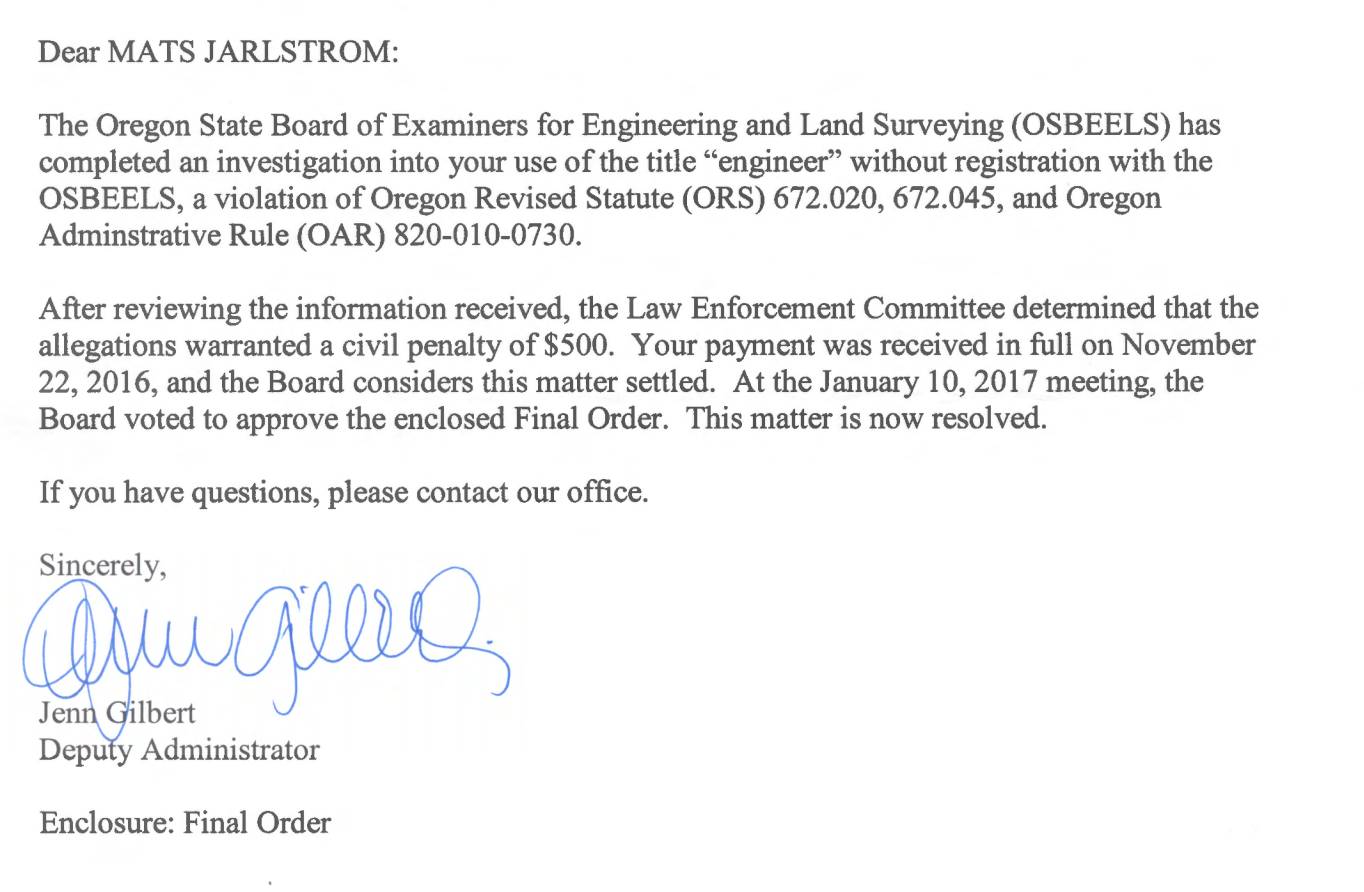
Man Fined $500 for Crime of Writing 'I Am An Engineer' in an Email to the Government.

I suggest for all of you to read the original article (see link below) and draw your own conclusions.

In summary, Mats Järlström, a private citizen with electrical engineering education, has written a well formed letter to his State Government. The letter specified facts about the shortcomings of traffic lights operations, providing important actionable information. Instead of responding to the good intentioned letter and fixing the problem, the State of Oregon, chose to pick on this Good Samaritan and nail him with a $500 fine for an obscure law violation. The State of Oregon claimed that Mats violated the law by declaring that he is an engineer, while he is not registered with the State.

Clearly, the State of Oregon is protecting the special interest of the old guilds through its actions and you can bet on entrenched interests doing their best to keep this situation forever. In these times, when innovation and science are open for all and new disciplines of engineering are opening up, the State of Oregon, in its official policy, is doing its best to keep us tied to the horse and buggy days and perhaps to the revival of the fur trapping and timber logging economy. Ancient regulations that do not keep up with the times, do not advance the interests of Oregon economy and will not create new jobs.

There is a good reason for the multi-billion budget deficit that the State of Oregon is facing for the next bi-annual budget, in spite of the high personal tax rates that the state treasury is collecting. The reason is the high cost of government. Part of this cost is apparently being spent on protecting the entrenched guilds constituency and the out of date policies of the pre-industrial revolution. For all of you who declare yourselves as "software engineer", or "electronics engineer", or "biochemical engineer", beware! The State of Oregon is coming to get you.


All the best.

--Dr. Flywheel

Thursday, March 2, 2017

Direct Participation In Democracy
Oregon District-1 Spring Town Hall Meeting Schedule

Congresswoman Suzanne Bonamici announced six town hall meetings across the First Congressional District, which includes Washington, Yamhill, Clatsop, and Columbia counties and part of Multnomah County.

Many of us live in the Oregon District-1 and would like to present our questions and comments to our representatives in a direct form. I encourage you to take the opportunity and participate in our democratic process directly, instead of letting the politicians learn about your wishes from paid consultants.

The Congresswoman’s schedule for town hall meetings is as follows:
McMinnville Town Hall Meeting
Date: Friday, March 3, 2017
Time: 6:00pm
Location: McMinnville High School, Auditorium – 615 NE 15th Street, McMinnville, OR 97128
Hillsboro Town Hall Meeting
Date: Monday, March 13, 2017
Time: 6:00pm
Location: Washington County Fair Complex, Main Exhibit Hall North – 873 NE 34th Avenue, Hillsboro, OR 97124
Warrenton Town Hall Meeting
Date: Saturday, April 15, 2017
Time: 11:00am
Location: Warrenton High School, Gym – 1700 S Main Avenue, Warrenton, OR 97146
Scappoose Town Hall Meeting
Date: Saturday, April 15, 2017
Time: 3:00pm
Location: Scappoose High School, Gym – 33700 SE High School Way, Scappoose, OR 97056
Sherwood Town Hall Meeting
Date: Monday, April 17, 2017
Time: 6:00pm
Location: Sherwood High School, Gym – 16956 SW Meinecke Road, Sherwood, OR 97140
Portland Town Hall Meeting
Date: Sunday, May 7, 2017
Time: 11:00am
Location: Lincoln High School, Gym – 1600 SW Salmon Street, Portland, OR 97205
Please note: Parking may fill quickly. Please consider carpooling or public transportation.
--Dr. Flywheel

Friday, February 17, 2017

Are We Heading Towards the Next Financial Crisis?

A recent report by the New York branch of the Federal Reserve Board indicates that the total household debt balance is approaching the record peak of $12.68 Trillion, reached in Q3 of 2008. The Q4 2016 number is reported at $12.57 Trillion.

(Click on image to enlarge)
The most alarming fact coming out of this report is that student loan 90+ day delinquency is rising sharply and consistently over the last two decades. The current student loan outstanding balance stands at approximately $1.3 Trillion. 

The following table (source: FRBNY), clearly shows that student loan default rate leads household debt-component delinquency by far. Note that FRBNY has warned in its previous reports that though the current delinquency rate is alarmingly high, the actual delinquency rate, as an indicator, is quite understated, since many student loans payback terms are deferred, while students attend school. Once the deferral period is reached, it is highly likely that we will notice a much more significant rise in the delinquency rate.

90+ day delinquency rates (known as "seriously delinquent")
CATEGORY1Q3 2016Q4 2016
MORTGAGE DEBT1.6%1.6%
HOME EQUITY LINE OF CREDIT2.0%2.1%
STUDENT LOAN DEBT 210.9%11.2%
AUTO LOAN DEBT3.6%3.8%
CREDIT CARD DEBT7.1%7.1%
ALL3.3%3.3%
1Delinquency rates are computed as the proportion of the total outstanding debt balance that is at least 90 days past due.

2As explained in a previous report, delinquency rates for student loans are likely to understate effective delinquency rates because about half of these loans are currently in deferment, in grace periods or in forbearance and therefore temporarily not in the repayment cycle. This implies that among loans in the repayment cycle delinquency rates are roughly twice as high.
(Click on image to enlarge)
While students' inability to pay back their loans in a timely manner, affects their credit scores as well as spending ability, in many cases this delinquency affects the economic reality of their parents, when parents co-signed as guarantors on their children's loans. Unlike other types of debt, this type of situation has the "passing-the-buck" effect that binds multiple generations together into Indentured Servitude. The economic impact on households that have a high debt to income ratio could have very dire consequences, as both parents and their children are forced into default. Since our government precluded student loan debt  from personal bankruptcy protection, there is currently no mechanism that could prevent a debt crisis.
(Click on image to enlarge)
Perhaps it is time to call out our government policies for a major review, regarding investment in education in general and the cost of higher education in particular. It is unclear why we have the most expensive higher education in the world, while other developed countries make higher education completely free for their citizens and permanent residents. With many countries in Europe (Germany, France, Scandinavian countries, etc.) offering free university education, at top universities (see references below), to foreign citizens (including U.S. citizens) are we going to begin shipping our young population abroad to seek debt-free destiny?

With hundreds of thousands of H1B visas granted to foreign workers every year and with even greater number of F1 visas granted to students who enter the U.S. workforce through "Optional Practical Training" (OPT) arrangements, U.S. Employers receive the short-term benefit of cheaper labor, all at at the entry level. However, by undercutting citizen children of the middle class in the U.S. from a chance to receive higher education, due to affordability issues, any short-term gain in worker supply will be replaced by a massive downfall and screaming shortages of well educated workforce in the long term.

Is it not the time to demand a major revision of the "for profit" approach in higher education? This system went overboard over the last 30 years, making college-level education un-affordable for so many people and enslaved those who received financial support for their education to a lifetime of debt. With the financial sector taking over every aspect of our lives and dominating the political system, are we going to sit at home and see this, once great country, going to the dump, while enriching the top 0.1 percent of the population?

Your comments are welcome.

--Dr.Flywheel

References:
Since the original date that this article was written the picture became even worse. The latest FRBNY report indicates a significant increase of ongoing consumer debt, as quoted below:
(Click on image to enlarge)
  • Aggregate household debt balances rose to a new peak in the second quarter of 2017. As of June 30, 2017, total household indebtedness was $12.84 trillion, a $114 billion (0.9%) increase from the first quarter of 2017 (the original article reported 12.57 Trillion, or a change of 270 billion since Q4  2016). This increase put overall household debt $164 billion above its peak in the third quarter of 2008, and 15.1 percent above its trough in the second quarter of 2013.
  • Mortgage balances, the largest component of household debt, which stood at $8.69 trillion as of June 30, saw a $64 billion uptick from the first quarter of 2017.
  • Balances on home equity lines of credit (HELOC) were roughly flat, and now stand at $452 billion.
  • Non-housing debt rose in the second quarter, with increases of $23 billion in auto loans and $20 billion in credit cards; student loan balances were roughly flat.
Reference: